

It is, by now, the accepted belief that at Glenrowan Ned Kelly was riding Joe Byrne’s grey mare, Music. But, with the available contemporary evidence, can we prove this to be the case?
Here’s what we know:
- Ned Kelly almost certainly rode a grey mare at Glenrowan. He referred to it as, “my grey mare” (although Sergeant Steele was adamant that he actually said, “my bay mare” and other reports back up this idea.) Quoth Ned Kelly: “I could have got away last night, for I got into the bush with my grey mare, and lay there all night.”
- The mare disappeared into the bush during the early stages of the siege when Ned tried to mount her.
- The same mare, still saddled and bridled, emerged from the bush during Ned Kelly’s last stand and was hit by a police bullet before bolting into the bush again. Quoth Dr. Nicholson: “…a horse with saddle and bridle came towards the place where the man (whom we had by this time ascertained to be Ned Kelly) was lying, and we fully expected to see him make a rush and mount it, but he allowed it to pass, and went towards the house.”
- The mare was located after the siege and claimed by the police.
- This horse was later sold off to a theatre manager.
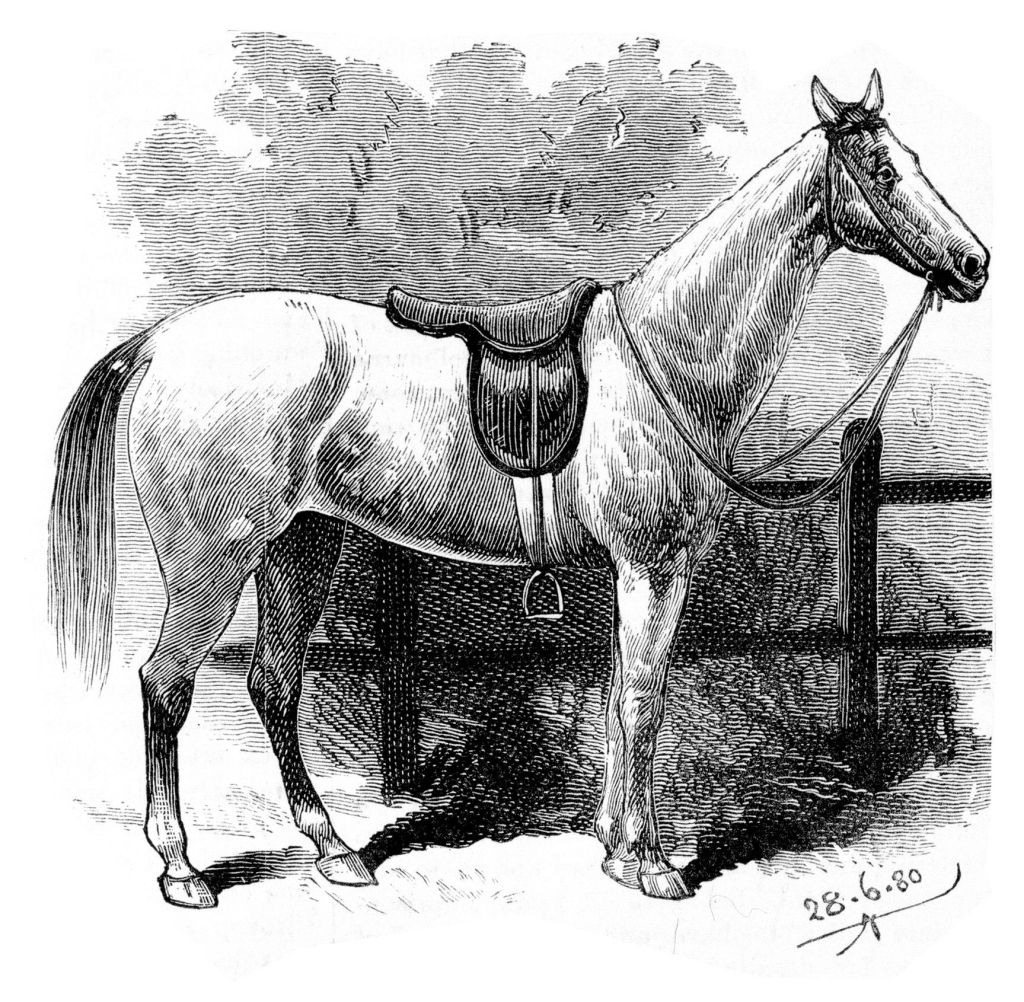
Five, rather broad, dot points is not a lot of information to go on, but it provides us with enough information to accept that at Glenrowan there was a mare that was associated with Ned Kelly.
“Music”
The first Kelly author to state the name of Joe’s horse was Music was Ian Jones. He was also the first to state that Ned’s bay mare was named Mirth. His basis for this information were his interviews with Joe’s sister Ellen, who was a child at the time of the outbreak and had no memory of her outlaw brother, and interviews with members of the Lloyd family. For the sake of simplification I will refer to Joe’s horse as Music henceforth and Ned’s bay mare as Mirth, despite there being no other sources to back the assertion.
We have no detailed description of Music beyond that she was a grey mare and that she was often ridden hard, and in one case after having recently given birth. On at least one occasion it was said that Music was the best of the gang’s four horses.
We know that the gang were usually spotted riding “three bays and a grey” if they were travelling together, as this was often reported in the press of the time. Because this was so well-known, it was not uncommon for some of the sympathisers to ride in the same formation to confuse the police.
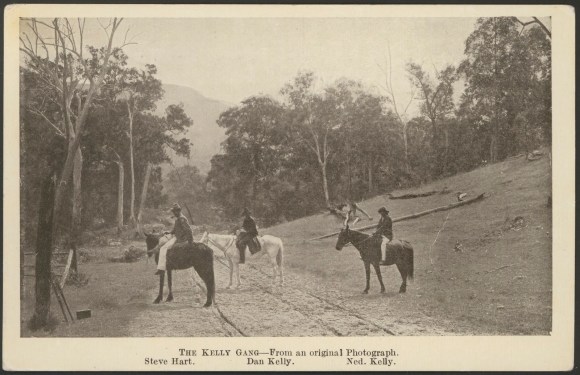
Paddy Byrne, Joe’s younger brother, purchased a similar grey mare so that he could distract the police. Joe and Paddy looked strikingly similar from a distance and the brothers would adopt the same hunched stance when riding so that police did not know which sighting to respond to.
It is more than likely this second grey mare was referred to in the Royal Commission by Superintendent Hare: “…at Mrs Byrne’s there was kept in training a grey mare, said to be for Joe Byrne. It was reported that this mare was taken out at two o’clock one morning, while the men were supposed to be watching the place.” It is odd, if the report is correct, that the insinuation here is that Joe’s primary mount, Music, would be kept at the Byrne farm.
Beyond these points there is not much else of note to be said about Music in contemporary records.
Did Ned have his own grey mare?
It is easy to imagine that Ned simply borrowed Joe’s horse from time to time, especially as it was believed to be the best of the horses the gang primarily had at their disposal. However, the possibility that Ned might have had a grey mare of his own has rarely been entertained.
The gang did not have an endless supply of horses of their own, but it seems likely that they might have had one or two each on the go that they could interchange when travelling long distance. It is far from implausible that Ned could have had a grey mare of his own in addition to his bay mare. For all we know, he may have had a grey mare from the same brood as Joe’s — there’s just no way to prove or disprove this idea.
Another important thing to consider is that Ned might have referred to the horse as his, even if it wasn’t. If it was an animal he rode often he might have felt some sense of ownership over it.
It was reported after the siege that, “Kelly spoke, as of a valued servant, of his grey mare, stating that he would rely on her to carry him away, with all his weight of armour, in the event of his being being pressed by the police.” This certainly sounds like the language one would associate with someone who was the owner of the horse rather than someone who had borrowed it. Is this a sign that the animal actually belonged to Ned, or that he had a problematic perception of how ownership works (his career as a horse thief, and later as a bank robber, may be indicative of the latter).
A curious thing is that in the weeks after Ned’s execution, Kate and Jim Kelly went on tour with a show that included some horses associated with the Kellys, including a horse they claimed was Ned’s grey mare, named Kitty. If Ned did own such a horse, and it was at Glenrowan, how did the family acquire it in time for the show, and why is there no account of them purchasing the animal recovered at Glenrowan?
A horse’s apparent sense of loyalty
If Ian Jones’ version of the Kelly story is to be believed as gospel truth, Ned had such an affinity for horses it bordered on paranormal and horses also have some higher intelligence and a sense of drama.
In his book, Ned Kelly: A Short Life, he states:
Now came a moment of such unreality that few men even recalled it. Music, the grey mare, had appeared among the misty trees of the hillside. Ned called her ‘my grey mare’, but she was really Joe’s, ridden by both men and loyal to both. As Ned knelt among the trees Music came towards him, saddled and bridled. It was as if Joe were offering his mate one last gesture of help, a chance to escape.
This dewy-eyed interpretation of the moment that the grey mare bolted from the bush, petrified by the shooting that was now directed at where she had been hiding, only serves to warp the perception of history. It is calculated to heighten the idea that Ned had some supernatural affinity with horses, which is a core aspect of the Ned Kelly mythology, and to suggest that Ned was so extraordinary a man that his friends would be so loyal that even after they died they would go out of their way to help him escape from certain death.
The reality is more mundane. In the early hours of the morning, some time between 3:00am and 4:00am, Ned decided to find an escape route at the back of the inn. His left arm was broken and he had been shot in the foot (literally, although figuratively he had also shot himself in the foot by effectively sabotaging his own plan). He tried to make Joe reload for him, and then tried to find a way out through the fence at the back near the horse paddock. He tried to mount a horse (the mare) but it got spooked and bolted, smashing through the fence and taking off into the bush on the Wangaratta side of the inn. Ned followed her on foot. He soon passed out from blood loss. Hours later, he woke up to find the path back to the inn blocked off by police. He decided to attack them from behind. The police turned to shoot at him, now directing their fire into the bush where the spooked horse had gone to hide. The shots spooked the horse again and it bolted out of the bush and in front of Ned. Rather than trying to grab the horse, Ned let it go. A bullet struck the horse and she took off towards the inn.
It was not a moment of a horse heroically trying to rescue its rider. It was not Joe Byrne’s spirit offering his mate a chance to escape. It was a terrified animal fleeing because police were shooting at it. That’s the reality. Jones spins a good yarn from the moment, but keep in mind that this is the same author that suggested that Ned Kelly’s eyes glowed red when he was angry or excited. The history, of which Jones was undoubtedly extremely well-versed due to his own extensive research, was dangerously mingled with flights of fantasy in A Short Life, and this helped sear it into the popular consciousness, which has caused many headaches for researchers and historians since then.
The recovered horses
A key part of figuring out the likelihood of what horse was the “grey mare” at Glenrowan is looking at the animals captured after the siege by the police. In a contemporary news report, titled The Flying Scud, this is the very subject.
In the report we learn that the horses the gang stole from Messrs Patrick and Ryan were reunited with their owners once the true ownership was ascertained. We also learn that all other animals that couldn’t be accounted for were kept by the police until a lapse of time allowed them to sell the horses off.
A memo from Hiram Crawford, a neighbour of the Sherritts, describes Ned and Joe’s horses:
The bay mare that Ned Kelly rode is seven years old, 16 ½ hands high — a grand jumper, and has taken three prizes at the local shows. She is a very fine mare, and perfectly sound. The chesnut horse that Joe Byrne rode is five years old, strong and sound.
What is curious about the article is that memos that are reproduced within it suggest that Ned was indeed riding a bay mare at Glenrowan. Take, for example, the following from Patrick Kelly of Cashel:
…the sum of sixty-five pounds, for the bay mare stolen from me by Ned Kelly, which was ridden by him and found in his possession when captured at Glenrowan. Brand R off shoulder, star forehead, two white hind legs to fetlock.
[…]
Note. — It is certain that this bay mare is the last horse that Ned Kelly ever rode, and I can refer you to any of the police — Senior-constable Kelly or to Mr Superintendent Sadleir — to prove it.
In fact, Sadleir is quoted in the article as stating that the bay mare was the one Ned was trying to mount during the siege.
We then get a description of the chestnut horse Joe rode:
Received the sum of £65 for one chesnut horse, with white face and two white hinds legs, branded near shoulder M R, This horse was ridden by Joseph Byrne from Beechworth to Glenrowan, and is one of the best cross-country horses in the North-Eastern district…
Hiram Crawford is again quoted in relation to enquiries about a grey mare:
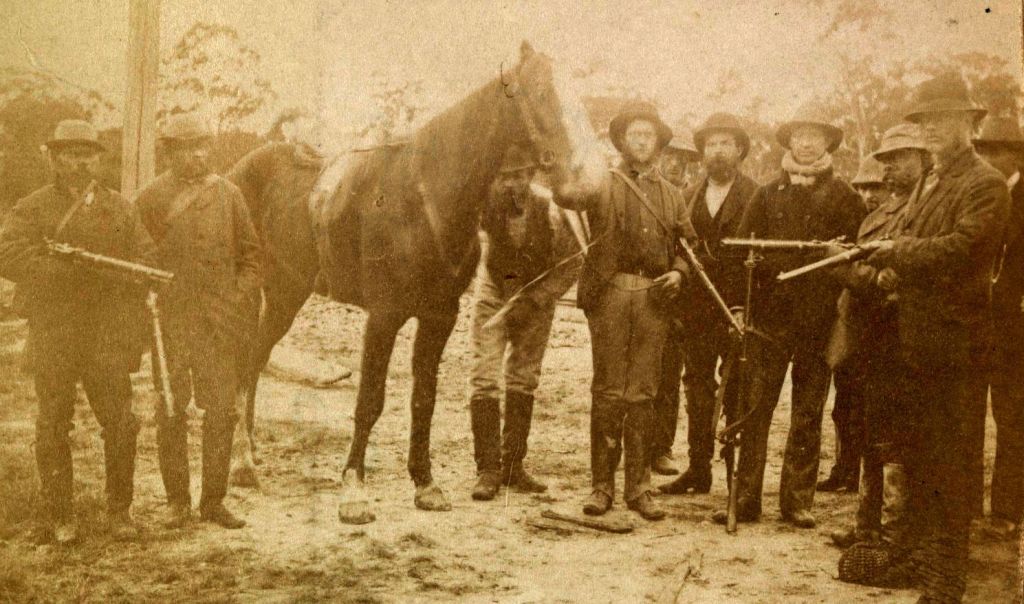
I saw several of the police at Benalla, on my return, and they inform me that the only grey horse found at Glenrowan was a wild mongrel that they lost taking to Benalla. It was an iron grey. Should it be found the police will claim it at once. At Wangaratta I saw Constable Steele, the trooper that took Kelly. He told me it was Ryan’s bay mare that Kelly spoke to him so much about. Kelly said to Steele; If I had my bay mare (not grey), all the constables in Victoria could not catch me. He referred to the bay mare I bought from Ryan for you, the one that Mr Holt wished to purchase. Steele described the mare to me — star in forehead, &c. There is no mistake about her.
The article concludes by stating the horses ridden by Byrne and Kelly were eventually acquired by the managers of the Theatre Royal, Melbourne, for £130 to be used in a production of The Flying Scud (hence the title of the article).
So, does this disprove the claims that it was even a grey mare at all? Maybe. Is there a chance that the police, having successfully captured Ned Kelly’s (or Joe Byrne’s) renowned grey mare, lost her on the way to Benalla and decided to cover up the loss by dismissing it as a mongrel horse? It’s not unfathomable. I expect they would have been raked over the coals if Standish, Sadleir, or any of the other superior officers had discovered such bumbling and the loss of what would have been a rather handsome trophy.
The Melbourne Leader of 3 July 1880 reported on horses found at Paddy McDonnell’s tavern the day following the siege, which had been stowed there by the outlaws:
A very fine upstanding chestnut horse was identified as the property of Mr. Ryan, of Major Plains. The horse was stolen from Mr. Ryan about sixteen days ago. There was a new saddle on the horse which had been recently made by Bullivant, of Wangaratta. It was the horse ridden by Joe Byrne on the night Sherritt was murdered. A brown mare, which had been used as a pack-horse, was also identified as the property of Mr. Ryan, and was stolen at the same time as the chestnut horse. Another brown mare was identified as the property of Mr. Fitzsimmons, stolen from his farm at the Ten-mile Creek about ten days ago. The other horse has not yet been identified. Ned Kelly’s favorite mare was seen in the bush near to Glenrowan during the progress of the fight. It is believed she is wounded.
Once again, we are given information that states Ned’s mare was at Glenrowan — This excerpt even states she was wounded — but it does not describe if she was a bay or a grey. Frustrating.
Yet, The Brisbane Telegraph of the same day (and many other papers that simply reprinted the same articles) reported that, “Ned Kelly’s grey mare has also been caught, and will be brought on to Benalla to-morrow.” So, at least in this case we know the police did in fact recover the mare, that she was grey, and she was set to be delivered to Benalla. No word on her being a “wild mongrel”, though.
Other reports around the same time described the police finding the horse as follows:
Ned Kelly’s mare was found along the railway line, a few miles from Glenrowan, saddled and bridled. The saddle resembled that of Byrne, and bears the name of the Wangaratta manufacturer. The mare has been identified by Mr. Ryan, farmer, of Major Plains, as one of the two stolen from a paddock on his farm on the night of last Thursday week. It is a splendid upstanding mare, nearly 16 hands high, and a grand horse for crossing any kind of country. Ned Kelly was quite enthusiastic over the excellent qualities of the animal. The horse ridden by Byrne was the second of the two stolen from Ryan’s farm. They were not stolen by the gang themselves, but by a sympathiser, who was seen crossing the railway line near Glenrowan with them on the Thursday night in question. Both were unshod when stolen, but have since been shod, evidently in a hurry, for the shoes were fastened very lightly, and were easily removed.
This description suggests that the mare found along the railway was the bay mare referred to by Hiram Crawford, once again creating confusion.
Another point that makes things more complicated is that police supposedly recovered a grey pony said to belong to Ned Kelly at Glenrowan. In the document, “List of property now and previously in possession of Sen Const Smyth at Benalla, in connection with outlaws,” there is a list of the horses belonging to the outlaws that were recovered:
1 grey pony, 1 brown pony mare, 1 chestnut horse, 1 bay horse, and one bay or brown horse (M?)
It is not likely that the grey pony that was described as being impounded and sold by the police could have been mistaken for a grey thoroughbred, and it seems preposterous that Ned Kelly would be riding a pony. This opens the space for the conspiracy theorists to step in and postulate that if the police had captured Music they may have recorded her as a grey pony that they sold to cover up what really happened to Ned Kelly’s horse (a claim that could equally be applied to when they said they lost the grey “mongrel” horse they recovered), i.e. they kept her as some kind of trophy — but that would be a fairly long bow to draw for most rational people without something a bit more solid to base that claim on.
So was it Music or not?
We simply do not have enough information to state definitively if “Music” was the grey mare at Glenrowan. To say otherwise is to wilfully ignore the lack of actual evidence. All we can state definitively is that a mare, that was most almost certainly a grey (but possibly a bay), was ridden by Ned to/at Glenrowan, while Joe rode the stolen chestnut horse to/from the Devil’s Elbow because it was better at travelling long distance. The Music story is certainly the best explanation we have with the available information.
What has complicated the process of sorting fact from fiction is that Ian Jones stated his interpretation of Ned Kelly’s story with such authority that questioning even minor points such as this can cause some people to react as if you are committing blasphemy. He was not the first author to publish such an in-depth biography of the outlaw, and he has been proven to be far from the last, but he told the story in such a way that it captured the imagination and opened people’s eyes to the fact that where history is concerned there is always something new to find, and sometimes those findings can completely recontextualise what we know. So it was with his claim that Joe Byrne’s grey mare tried to save Ned Kelly’s life at Glenrowan: a small and oft-overlooked moment when looked at from a new angle can raise all sorts of questions, and suddenly what seemed insignificant becomes an important part of the story.
Selected sources:
Destruction of the Kelly Gang — Further Particulars
Regarding Items the Police Recovered from the Gang
The Kelly Gang (05/07/1880)
The Kelly Gang (06/07/1880)
Jones, Ian & Hachette Australia Ned Kelly : A short life. Hachette Australia, Sydney, New South Wales, 2010. [page 233]

 Glenrowan