
Telegraph (Brisbane, Qld. : 1872 – 1947), Monday 5 July 1880, page 3
THE KELLY GANG.
FROM telegraphic reports to the Sydney newspapers we are enabled to supply the latest particulars of the overthrow of the Kelly gang and the capture of Ned Kelly.
STATEMENT OF FATHER GIBNEY.
M. Gibney said: I am a Catholic priest of Perth, West Australia; I was travelling on the north-western line, having left Melbourne by the first down train ; in the morning, on arrival at Glenrowan station, having heard while going there that the Kelly gang were at Jones’s hotel, I got out of the train, abandoning my intention to proceed further on; consequently my presence at the scene was, so to speak, accidental ; I got out at Glen-rowan because I thought I might be of use in my clerical capacity ; the train arrived at Glenrowan between 12 (noon) and 1 o’clock; and I went at once into the room where Ned Kelly was lying at the station; I don’t think he is dying; he is penitent and shows a very good dis-position ; when I asked him to say, “Lord Jesus, have mercy on me,” he said it, and added, “It is not to-day I began to say that ;” I heard his confession, which I shall not be expected to repeat ; as I at first thought he was dying, I anointed him ; Kelly freely confessed his intention of wrecking the train.
NED KELLY’S INTERVIEW WITH HIS SISTERS.
After the house had been burned, Ned Kelly’s three sisters and Tom Wright were allowed an interview with him. Tom Wright, as well as the sisters, kissed the wounded man, and a brief conversation ensued, Ned Kelly having, to a certain extent, recovered from the exhaustion consequent on his wounds. At times his eyes were quite bright, and, although he was of course excessively weak, his remarkably powerful physique enabled him to talk rather freely. During the interview he stated: “I was at last surrounded by the police, and only had a revolver, with which I fired four shots ; but it was no good. I had half a mind to shoot myself. I loaded my rifle, but could not hold it after I was wounded. I had plenty of ammunition, but it was no good to me. I got shot in the arm, and told Byrne and Dan so. I could have got off, but when I saw them all pounding away I told Dan I would see it over and wait until morning.”
“What on earth induced you to go to the hotel?” inquired a spectator.
“We could not do it anywhere else,” replied Kelly, eyeing the spectators who were strangers to him suspiciously. “I would,” he continued, “have fought them in the train, or else upset it, if I had the chance. I did not care a—— who was in it, but I knew on Sunday morning there would be no usual passengers. I first tackled the line and could not pull it up, and then came to Glenrowan station.”
“Since the Jerilderie affair,” remarked a spectator, “we thought you had gone to Queensland.”
“It would not do for every one to think the same way,” was Kelly’s reply. “If I were once right again,” he continued, “I would go to the barracks and shoot every one of the —— traps, and not give one a chance.”
Mrs. Skillian to her brother: “It’s a wonder you did not keep behind a tree.”
Ned Kelly: “I had a chance at several policemen during the night, but declined to fire ; my arm was broken the first fire ; I got away into the bush and found my mare, and could have rushed away to beggary, but wanted to see the thing out, and remained in the bush.”
A sad scene ensued when Wild Wright led Mrs. Skillian to the horrible object which was all that remained of her brother Dan. She bent over it, raised a dirge-like cry, and wept bitterly. Dick Hart applied for the body of his brother, but was told he could not have it until after the post-mortem examination.
TAKING NED KELLY TO MELBOURNE.
Shortly after eight o’clock on Tuesday morning a spring-cart emerged from the local police barracks, and was driven down the street at a slow pace. It was accompanied by eight armed policemen on foot, and the curiosity of the townspeople was naturally excited as to what the vehicle contained. A peep over the side showed that, inside, on a stretcher, lay the wounded outlaw Ned Kelly, formerly the terror of the district. The police were conveying him to the railway station, and were all fully armed, lest any attempt might be made by sympathisers of the late gang to rescue him. On the arrival of the train Kelly was carried carefully to the guard’s van, and laid on the floor. Miss Lloyd, cousin of the outlaw, was the only relative present, and as the train left she cried without restraint. Just before Ned Kelly was taken away from Benalla, senior-constable Kelly had a short interview with him in his cell. The senior-constable said, “Look here, Ned. Now that it is all over, I want to ask you one question before you go, and that is, did you shoot constable. Fitzpatrick, at Greta, when he went to arrest your brother?” The prisoner replied, “Yes, I did; I shot him in the wrist, and the statements which have been made that Fitzpatrick inflicted the wound himself are quite false.” This, it will be seen, bears out the statement made by Fitzpatrick, and subsequently by Kelly’s sisters. Of course it will be remembered that the shooting of Fitzpatrick was the original cause of Ned and Dan Kelly taking to the bush. The senior-constable also talked with the outlaw about the police murders. He told him that Mrs. Kennedy had telegraphed to know whether he had got a letter for her from her murdered husband. Ned Kelly replied that he had got no letter from Sergeant Kennedy, and that Kennedy never uttered a word after he was brought down, except “God forgive you.”
“I shot him,” continued the outlaw, “He kept firing all the time, running from tree to tree, and tried to kill Byrne, until his ammunition was done.”
PHOTOGRAPHING BYRNE’S CORPSE.
During the forenoon the body of Byrne was brought out of the lockup where it lay, and slung up in an erect position on the outside of the door, the object being to have it photographed by Mr. Burman, of Melbourne. The features were composed in a natural way, and were easily recognised. The face was small, with retreating forehead, blue eyes, the upper lip covered with a downy moustache, and a bushy beard covering his chin, whilst his hair had been recently cut. His figure is that of a tall, lithe young fellow. The spectacle, however, was very repulsive. The hands are clenched and covered with blood, whilst blood also covered his clothes. The police soon had the body removed from the public gaze. The officers, policemen, trackers, and gentlemen who were there at the Barracks, and who were present at the encounter, were also photographed in a group. During the day Detective Ward proceeded to Glenrowan, and on making some inquiries discovered five of the horses of the gang stabled at Macdonnel’s Railway Hotel, which stands on the east side of the line opposite the scene of the fight. They had evidently been fasting ever since they had been stabled there, which of course was on the arrival of the gang two days ago. Why Mr. Mc’Donnell did not give voluntary information to the police concerning the horses has not been explained. They were all brought to Benalla, and two of them were identified as horses which were stolen within the last fortnight from Mr. Ryan’s farm, on the Major Plains. One of the two was ridden by Joe Byrne when he committed the murder of Sherrett, at the Woolshed, near Beechworth, on Saturday last. A third was recognised as a packhorse belonging to Mr. Fitzsimmons, of Benalla ; and was stolen from his farm, near Greta, about twelve days ago. The other two have not yet been identified. Ned Kelly’s grey mare has also been caught, and will be brought onto Benalla to-morrow. On one of the horses was found one of the Government saddles taken from the police horses on the occasion of the Mansfield murders.
CHERRY MURDERED BY NED KELLY.
The poor old man Martin Cherry was murdered in the most diabolical manner by the infamous leader of the gang and was not shot by the police as was supposed. The fearful deed was witnessed by only three of the prisoners confined in the hut. All those have made written statements, which are corroborative in every particular. It appears that after the first volley fired by the police Ned Kelly rushed inside the house. He had been wounded in the arm, and was like a wild beast. Nearly all the prisoners were huddled together in the parlour. Ned Kelly ordered Cherry to pull down the blinds of the window on the side, so that those outside could not see where the fire was. Cherry replied, “I will not do that, I would be shot ; you had better do it yourself.” The fierce outlaw held a rifle in his hand, and turning upon the poor old man shot him. Cherry fell, and some other members of the gang carried him to the kitchen, where he was found when the house was on fire.
John Mcillroy, a relative of the Kellys, on Thursday asked Superintendent Sadlier for his influence to gain permission for himself, Miss Lloyd and Mrs. Skillian, to see Ned Kelly in Melbourne Gaol. Mcillroy was at the funeral at Greta, and stated that the threats used there were the foolish statements of drunken men.
WHAT NED KELLY LOOKED LIKE.
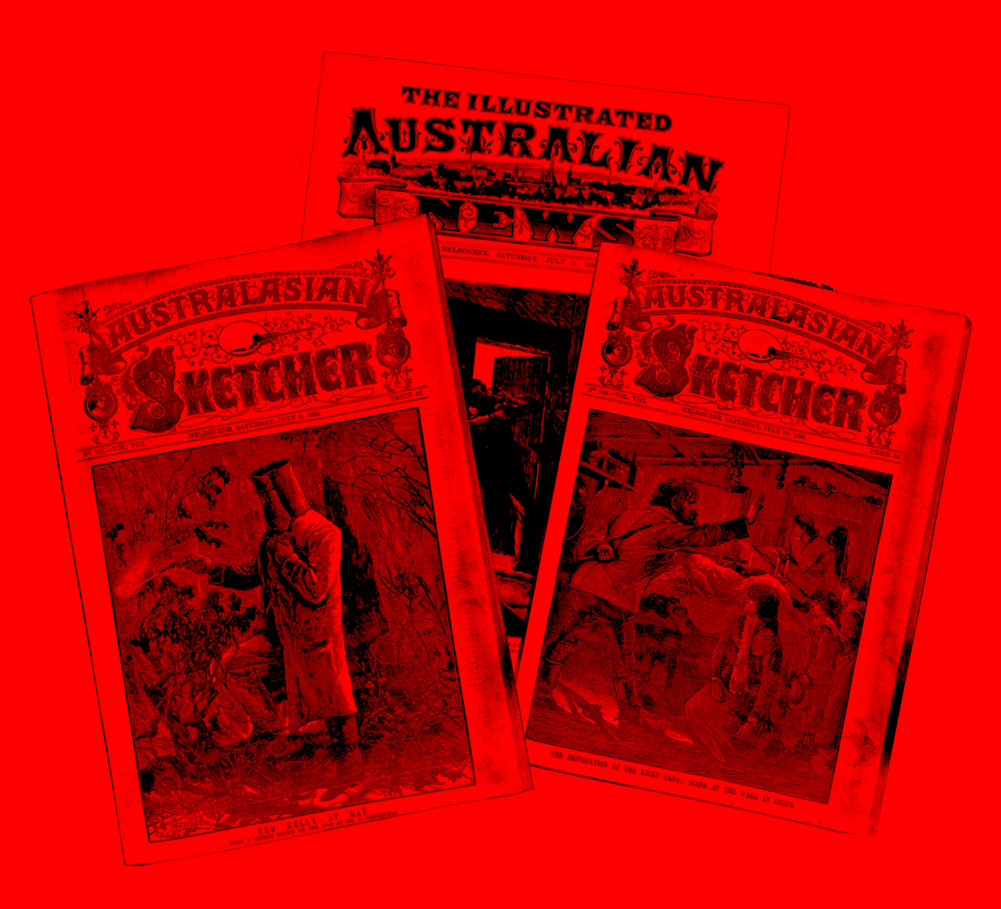
Constable Arthur, who assisted to take Kelly, states that while posted in the rear of the hotel, and peppering away at it from be-hind a log :— “It was very cold, and I filled my pipe to have a smoke. Just at day-light I was in the act of lighting my pipe, and heard Ned Kelly coming behind me. His extraordinary appearance so startled me that I let the pipe drop out of my mouth, and gazed at the strange object for a minute, not knowing but that it was a madman who had conceived the idea of storming the hotel, with a nail-can on his head. I then said to him, ‘Go back you d—— fool, you will get shot.’ The figure replied, ‘I could shoot you sonny,’ and at that moment fired his revolver at me, but missed. He evidently was crippled and did not take proper aim. We were then only between 20 and 30 yards apart. I levelled my Martini rifle and fired at his helmet, thinking I would knock it off. It only staggered him slightly. An opening in the helmet looked like a huge mouth, and I fired at that, and hit him again. He still came on. I fired a third shot at his body, and heard it scud off him. I was completely astonished, and could not understand what the object I was firing at was. The men around me appeared astonished too. Someone said ‘He is a madman!’ Dowsett, the railway guard, said ‘He is the devil!’ Sergeant Kelly exclaimed, ‘Look out, boys, he is the bunyip!’ At once I sought shelter, and tried to get round at the back. I did so because I found it was no use firing at him in front. Before I could succeed in doing so Sergeant Steele ran up from behind and shot him. When I shot at him first Sergeant Steele thought I had made a mistake, and told me to stop firing. After he had been captured, Kelly shook his fist at me and swore.”
[Constable Arthur is the man Ned Kelly said was a very fine shot.]
THE INTERVIEW BETWEEN KELLY AND HIS MOTHER.
Was of a very affecting character, to those who witnessed it. Ned, though not demonstrative towards his mother, or exhibiting very much emotion, nevertheless showed that he was sensible of the painfulness of the meeting. He exhibited a proper filial affection, according to his own rude nature, and she, on her part, exhibited that maternal instinct and solicitude which is hardly ever absent. She is described as a woman who, on a farm, would probably be agreeable in her way, and useful. Mrs. Kelly has now returned to her former occupation in the workroom of the gaol. It is probable she will be allowed to have another interview with him.
NED KELLY’S SCHEME.
At the interview with Senior-constable Kelly the outlaw was at first communicative, but afterwards became obstinate and refused to continue; but, from some other remarks that fell from his lips, and from circumstances that subsequently transpired, there is no doubt that the gang intended to put on their armour, walk deliberately up to the train when it fell off the line, and every living soul that escaped from the ruins they would have shot like dogs, and left not one alive. By this means they could have got rid of the body of police from Benalla, and they would go to that place and stick up one of the banks there, as, cased in their bullet-proof armour, they could walk into a bank and take what they wanted. They could have gone to the police station and taken possession of it ; then, with the railway lines torn up, and the telegraph wires cut, they could have held the town for a week. It was always Ned Kelly’s ambition to stick up Benalla. When spoken to on the subject, he scowled fiercely. “Yes,” he said, “and if you had not sent up that pilot engine, and that —— schoolmaster had not given the train warning of danger, you would have been up a tree.”
MRS. KELLY IN MELBOURNE GAOL.
Ned Kelly’s mother is a prisoner in the gaol, and on Wednesday last was allowed to see her son. It may be explained that Ellen Kelly, on the 9th October, 1878, was sentenced at the Beechworth Circuit Court, by Mr. Justice Barry, to three years’ hard labour for having wounded Constable Fitzpatrick at Greta, while he was arresting her son Ned on a charge of horse-stealing. That occurrence was the commencement of all the Kelly troubles which have since stained the criminal annals of the colony, and brought death, misery, and sorrow into a number of families. Mrs. Kelly has now been an inmate of the female division of Melbourne Gaol for nearly two years. She is a well-conducted woman in the establishment, and will probably have nine months remitted from her sentence. She would therefore be discharged in January next, a little more than six months hence. Father Aylward was the first person to communicate to Mrs. Kelly some intelligence of the dreadful occurrences of the last few days. It was evident she was terribly grieved at the tragical news. Father Aylward told her of the desperate encounter with the police on Monday night, and she immediately told him that on that same night she dreamt that such an encounter had taken place. Mrs. Kelly had come from the workroom, where she had been employed, to see the clergyman, but after her interview with him, she requested not to be taken back, and to be left alone to her grief. This request was complied with.
THE SCENE AT THE WAKE.
The scene at Greta, when the charred remains of Hart and Dan Kelly were carried in by their friends was (says the correspondent oi the Evening News) perfectly indescribable. The people seemed to flock from the gum trees. There were some of the worst looking people there I ever saw in my life. The two bodies were carried into Mrs. Skillian’s amidst the wailing and groaning of over 200 people. They were laid down on the table side by side, a dreadful sight. Their friends rushed the hut to catch a glimpse of them, but Mrs. Skillian took down a gun and threatened to blow out the brains of the first person that entered her house without her permission. She then allowed only three at a time to enter, and after they had remained only sufficient time to walk round the table and look at the bodies, they were turned out again. The first who went in were two girls and an old man, a relative of Hart. He cried like a child. Then Tom Lloyd and Quinn went in. They looked at the bodies for a moment and then Tom Lloyd took hold of Kate Kelly’s hand, and lifting his right arm to heaven swore a most dreadful oath that he would never leave their deaths unavenged. All day long scenes like these continued. Drink was brought over from Mrs. O’Brien’s hotel, and they were all, more or less, in a state of intoxication, and dangerously inclined. Lloyd seemed to be the most sober of the lot, though he was drunk enough. He went out into the clearing at the back of the hut with Mrs. Skillian, and the two kept in conversation a long time. A number of papers were passed between them both. Then Lloyd got on his horse and rode off to Benalla. He came to
BEG THE BODY OF BYRNE.
Of course this was denied him until after the magisterial inquiry had been held, and he hung about the police station attempting to enter into conversion with every constable he could. He kept appealing to their good nature, and asking them not to be too hard. He was in a state of the greatest anxiety to know what the police were going to do next, and seemed to be afraid that he and some others would be arrested as sympathisers. “What are you going to do with us, Mr. Kelly?” he asked of the constable there. “I don’t know, Tom. You had better keep out of the way and behave yourself.” “Oh, for God’s sake, don’t interfere with us. We have done you no harm, Be satisfied with the work you have already done, and leave us and the poor girls in peace. Our load is hard to bear.” Tears actually started out of his eyes when he spoke. Another person, who seemed to act under instructions from Mrs. Skillian, was Wild Wright. He stayed at Mrs. M’Donnell’s hotel, at Glenrowan, all Monday night, and all day on Tuesday. He sat up with her in the bar, and conversed in earnest whispers with her. All Tuesday night they had a number of papers spread out on the counter, which they were constantly arranging and re-arranging.

 Glenrowan
One reply on “The Kelly Gang (05/07/1880)”
[…] The Kelly Gang (05/07/1880) […]
LikeLike