
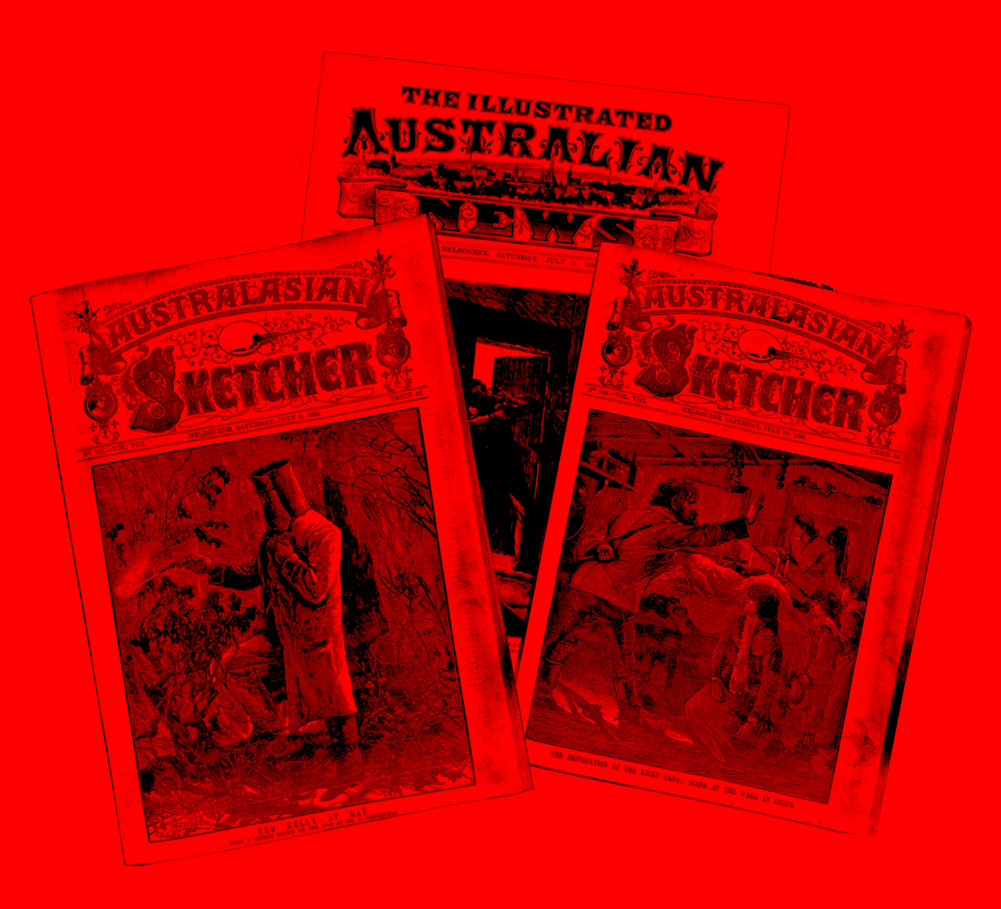
Sydney Daily Telegraph (NSW : 1879 -1883), Tuesday 29 June 1880, page 3
DESTRUCTION
OF
THE KELLY GANG.
——◆——
THREE OF THE BUSHRANGERS SHOT AND BURNED.
——
NED KELLY WOUNDED AND CAPTURED.
——
SEVERAL INNOCENT PERSONS SHOT AND INJURED.
The excitement in Sydney yesterday, consequent upon the fresh outbreak of the Kelly gang in Victoria, and the final deaths or capture of the entire party, has not been paralleled since the news of their first atrocious murders in October, 1878, sent a feeling of horror throughout the colonies. The telegrams in the morning papers, which recorded the reappearance of the outlaws, their approach by stratagem to a hut occupied by one who was giving information of their movements to the police and by four policemen, the shooting down of the man they more than suspected of betraying them, their siege of the police for twelve hours, and their final disappearance without anyone knowing the direction they had taken — all these circumstances had left the public from an early hour of the morning in a condition of most anxious uncertainty, and the newspaper offices were crowded by inquirers all desirious of knowing if “there was any more news of the Kellys.” At 10 o’clock news indeed came, for a notice was placed outside the Sydney Daily Telegraph office, and a second edition of the paper issued very shortly, after, announcing the capture of the notorious Ned Kelly, the leader of the band of desperadoes, and that the remaining three were in an hotel surrounded by the police, between whom and the ruffians a regular battle was proceeding. As the day wore on telegram after telegram, in most instances brief fragmentary, but exciting, came to hand and was printed and issued in successive editions of this paper. Until 8 o’clock in the evening, however, nothing like a connected account of the movements of the gang from the time they left Skerritt’s house, or of the circumstances in sequence that terminated with the deaths of Dan Kelly, Hart, and Byrne, and the conveyance of the wounded wretch, Ned Kelly, to Melbourne gaol, had arrived. But at the hour above mentioned we received from our Melbourne correspondent a telegram placing the whole events of so eventful a day in proper order and sequence, and an Extraordinary was at once published, which was circulated everywhere through the crowded streets and in the various theatres and places of amusement. And this places us in a position to give our readers a proper narrative, from which they can see how the career of the boldest and most cruel set of bushrangers that have ever darkened the pages of Australian criminal history was terminated.

 Glenrowan