

Herald (Melbourne, Vic. : 1861 – 1954), Thursday 18 November 1880, page 2
THE PHRENOLOGICAL CHARACTER OF EDWARD KELLY.
By A. S. HAMILTON, PHRENOLOGIST.
TO THE EDITOR OF THE HERALD.
SIR,— The outline which I propose to give of the character of Edward Kelly is drawn entirely from phrenological data; and as I have given proofs of the correctness of my phrenological judgment of more than one executed criminal, of whose character I had no previous knowledge before the examination of his head, I trust that the public, and especially the authorities of the law, may give due consideration to the character herein drawn in strict accordance with phrenological science. I may here state that I am willing to make a personal examination of the heads of all prisoners confined in Melbourne or Pentridge gaols, and give a clear account of their different tendencies to crime from the forms of their heads. The coiner, the forger, the burglar, the loafing swindler, who raises money by false pretences, the violent criminal in confinement for his violence, the violator of woman, the manslaughter criminal, and the murderer have all different types of brain, and I offer to prove that, in all marked cases, phrenology will guide me to a correct judgment.
The science of phrenology is based upon cerebral physiology, which treats upon the various organs of the brain; and psychology, its nearest of kin, treats of all mental phenomena arising out of the innate and circumstantial activity of the cerebral organs, Science is at once the custodian and revealer of truth, and as such it must be held sacred and command the reverence of all men who claim to be gifted with sufficient intellect to entitle them to the position of leaders or guides in the direction of public opinion upon questions of universal interest.
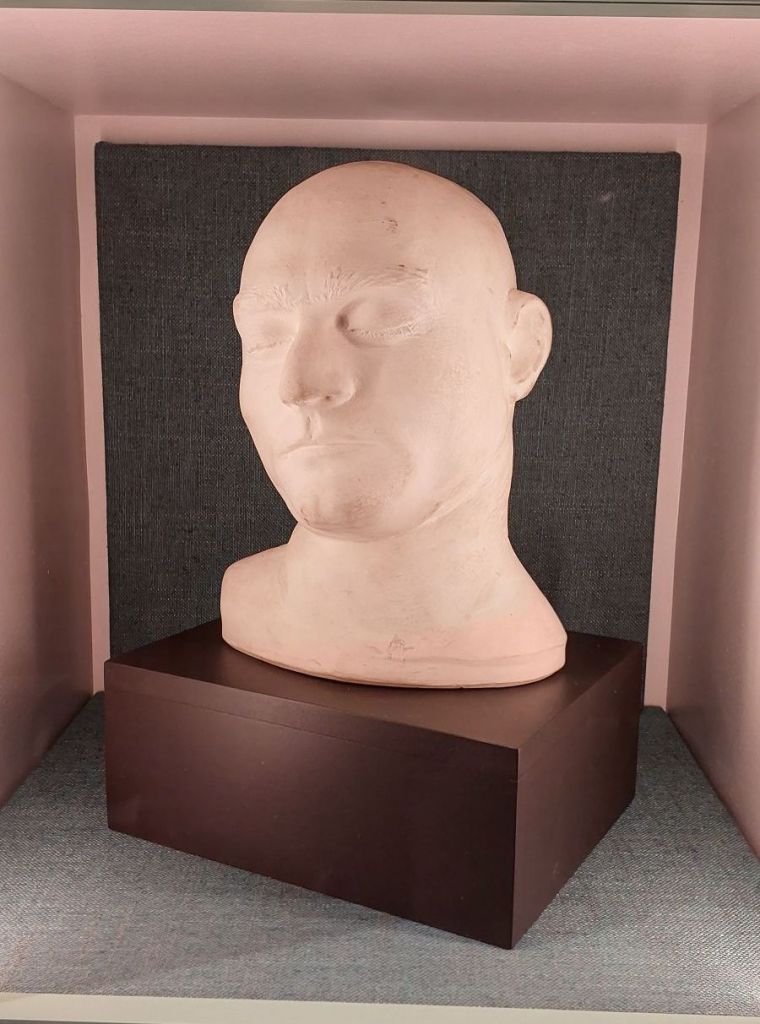
Forty years of daily study of the links in the chain of connection which subsist between brainal development and human character, between hereditary predispositions and the forces of external circumstances, have enabled me to arrive at clear convictions upon the questions of the qualities and degrees of crime, their cause, their punishment, and their cure. Of course perfect clearness of judgment upon matters of such magnitude and complexity is not to expected; but the evidence of science being palpable, the conclusions drawn are logical as far as they profess to reach. The following sketch of character is deduced from a careful examination of the cast of Edward Kelly, taken immediately after his execution. To Mr Kreitmeyer, I am indebted for the opportunity of making a phrenological analysis as he took the cast. As I did not take any part in the act of taking the cast Mr Kreitmeyer is wholy responsible for its correctness; and I may say that, after very many years’ experience in such work, I never saw a more perfect work, especially of the face, forehead and temple :—
Measurement with tapeline:— Circumference of the head 22 inches; length over the head from occipital spine to root of nose, 13½ inches, from opening of ear to ditto over the head, 13¼ inches. From cautiousness to cautiousness, or from centre of parietal bone to ditto over the crown of the head, 5½ inches. Across the forehead from acquisitiveness to ditto, 8 inches. From constructiveness to ditto over benevolence 9½ inches. From opening of ear to centre of individuality, 6 inches, From opening of ear to comparison, 6¼ inches. From self-esteem to comparison, 7 inches. These measurements to the phrenologist are remarkable. The head is of scarcely medium size for so big a man. The measurement from caution to caution is fully an inch less than it should be in a well-proportioned head; and in the moral region there is a deficiency of one inch. In the width from acquisitiveneness to ditto there is fully one inch more than is usual; therefore in circumspection and in moral regulating power there is a marked deficiency; while there is a woeful lack of development in those organs which give reflective judgment and stability to character, as will be seen when the relative proportions of the different organs are examined.
Relative proportion of the cerebral organs:— Very large, 20; large, 18; nearly large, 16; feeble, 14; very feeble, 12; small, 10; very small, 8. It is to be understood that all organs marked under 18 are less than they should be in a well balanced head, and that all marked 20, especially when they belong to the animal nature, are very dangerous to society, unless they are balanced by a large moral and reflective development. Preservativeness 16, alimentiveness 18, adhesiveness 10, inhabitiveness 16, continuity 16, cautiousness 14, combativeness 19, destructiveness 20, acquisitiveness 20, secretiveness 18, constructiveness 18, self-esteem 20, love of approbation 19, firmness 18, hope 18, veneration 17, benevolence 17, philoprogenitiveness 16, wonder 17, ideality 10, sublimity 16, conscientiousness 14, imitation 18, tune and time 17, individuality 19, form 17, size 19, weight 19, color 17, locality 20, number 17, order 17, eventuality 17, language 17, comparison, 17, causality 15, wit 16, amativeness 19, marriage 16. A glance at these numbers will show that all the organs which impart the spirit of opposition, destructive fire and passion, love of gain, love of praise, love of power, and amorous desires are all very strong; and that cautiousness, affection, friendship, justice, love of offspring, benevolence and reason are all weak, hence the danger to society of a man whose social affections are not strong enough to make him value the humanities of society, whose leading motives are utterly selfish, and whose spirit of revenge is aroused to a murderous extent towards those who resolve to apprehend him for his lawless conduct against society.
It is no excuse for Edward Kelly’s conduct to say that I could find many heads of as low a type as his in an hour’s walk in Bourke street, where the crowd is afloat which haunt the dens of infamy in that neighborhood. But though the type is much more common than is generally believed, it differs from Kelly’s in this, that there is not one head in a thousand of the criminal type so small in caution as his, and there are few heads among the worst which would risk so much for the love of power as is evinced in the head of Kelly from his enormous self-esteem. This self-esteem, combined with large love of approbation and hope, would often make him appear bright, dazzling and heroic to those who could not see through the veil which vanity threw around him. His love of family, his pride in the Kellys, is chiefly inspired by his self-esteem, and by the homage which was paid to his so-called courage and liberality. Having no fear of the future, as hope is large and no gloomy thoughts of the past, as cautiousness and causality are small, he could undergo the banishment from society for a while, in the hope of being enabled by a stroke of good luck to redeem his lost time as soon as he saw his way to escape from the vigilant eyes of the police who dogged his steps. This large hope bore him up as long as there was no appearance of imminent danger; and when at last he resolved to make a desperate effort to strike terror into the police by fighting them single-handed in his bullet-proof mail, his hope and vanity so overpowered his judgment as to cause him to throw himself with the fury and imbecility of a madman into the arms of his captors. A little more caution and a little less conceit would certainly have enabled him to hold his life a little longer. When the mystery of the Kelly gang is fully solved, it may be found that its leader was stimulated by something more than hope of vengeance on the tragic morning of his inglorious capture. Be that, however, as it may, artificial stimulants could only arouse to greater fury passions of vengeance, which, from force of circumstances, had been smothered for months, and which the outlaw felt compelled to manifest to save himself from raving madness. He had no intention of surrendering; no hope, no wish, but to bring his enemies, the police, to his feet. Had he been able to do so, and been successful in another bank robbery, he would have cleared out if a chance to escape presented itself, as no man with his ardent nervous temperament and his passion for freedom and power could long submit to a life of inactivity in some hiding place in the mountains.
It is well to understand the power of that consuming fire that burns into the soul of an outlaw like Edward Kelly; for without a knowledge of his physical and mental constitution, upon phrenological principles, it is impossible to understand his mental suffering under restraint. Thus our leaders in criminal jurisprudence would act wisely to study the organisation of notorious criminals, with a view to their classification and treatment in prison. The presence of a man like Kelly among those in his own sphere in life is pregnant with incalculable evils. The boy Dan, his brother, young Hart, and Byrne, and no doubt many others, were often literally magnetised by his power over them. Masterly self-esteem, and the utter absence of all personal fear when his vanity was active, the contagion of a bold hopeful spirit, and a total disregard of truth and all future consequences acted like a charm upon his mates, and threw a spell over the victims and witnesses of his adventures which confirmed him in his sense of superiority, and left them powerless and unable to use their usual courage and discretion. Whenever a man is believed to be totally regardless of his own safety he is looked upon as a hero. This Kelly had repeated opportunities of proving. Therefore we find him profiting by his experience of the credulity of others, and each step as he moves in his desperate course is marked with increased firmness, effrontery and disregard for law and right. He is not without a little benevolence, and he is not without some respect for those who acknowledge the talent and superiority of Edward Kelly; but benevolence and veneration are far too weak to cope with the burning fire of his destructiveness or the grand idea of himself presented by his self-esteem; therefore, reverence and benevolence with him are conditional and are all subservient to self; though, when relieved from all the external excitements of bush life, and confined to the diet and discipline of a gaol, and when visited by his priest, he does manifest some tokens of religious feelings, some small consciousness of having offended a Power higher than himself. His large secretiveness made him cunning and ambiguous, but his vanity was too much even for his cunning. His powerful acquisitiveness made him covetous, but his lack of caution made him improvident; and his lack of conscientiousness and great egotism made him feel that money in banks, or in the coffers of the rich, was only waiting there to be appropriated by him when opportunity offered to gratify his cupidity. He could take from the rich and give to the poor as long as the latter deferred to him as the cleverest man in the country. Power, praise, freedom and money were equally valued by him, and his acts which had the appearance of charity were dictated by vanity or performed from thoughtlessness, just as the humor of the moment suggested.
His smile in death was the result of active hope, self-esteem and firmness. No doubt in same degree, too, it arose from the calm of his mind under the pressure of the pious offices of the priests. Hope never long forsook him, self-reliance always stood his friend, and no doubt, like Burgess, he was so impressed with a sense of his own importance and buoyed up by false hope that he entertained no fear of future punishment. He was wonderfully vigilant and quick in perception, had some taste for neatness and order, a strong sense of his personal beauty, and a full consciousness of his capacity for athletic exercises and all the rough-and-ready dexterity of bush life. His language is fair, but it would be rendered prompt and passionate by his fiery passions, or ambiguous by his secretiveness and his absence of conscientiousness. Music and taste for the beautiful are evinced in the full form of his forehead over the eyebrows and across the temples; and his constructiveness is good; so that when he chose he could be smart in handicraft, although his fiery and roving spirit would prevent him from settling long to mechanical work.
To sum up in a sentence, his brain is abnormally wide at the base, tapers narrowly towards his self-esteeming crown, is retreating at the upper region of the forehead, is remarkably broad and deep over the eyebrows; and though it is rounded over the coronal surface by large hope and fair veneration, it is, in the moral region, deplorably low. His face is marked with good features, small mouth, handsome nose, resolute and firm chin, and his eyes must have been strong and well-formed, as they even look handsome while closed in death. May this be the last sketch of character of an executed criminal written by me, as the task is a painful one.
To-morrow, with your permission, I will have something to say on capital punishment.

 Glenrowan