
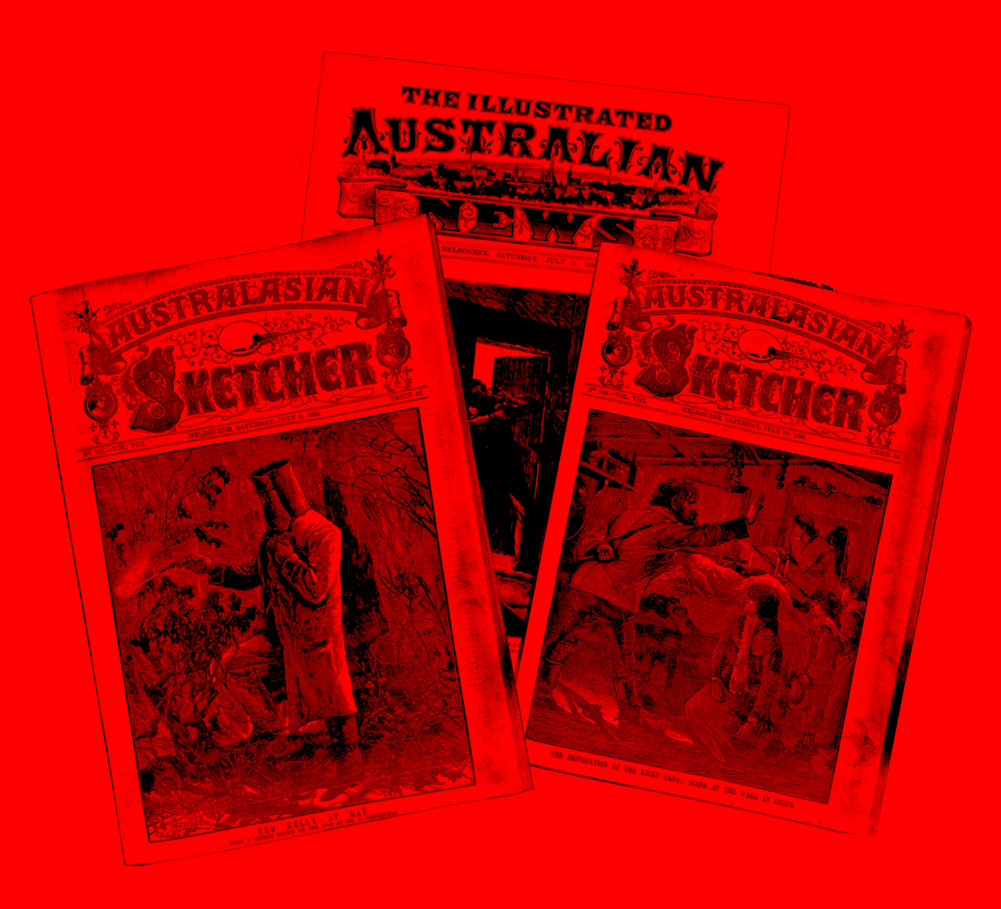
Illawarra Mercury (Wollongong, NSW : 1856 – 1950), Tuesday 6 July 1880, page 4
THE KELLY GANG.
(From the Herald’s Telegrams)
Benalla, Wednesday.
It is stated that Dick Hart openly dared this police at M’Donnell’s hotel, Glenrowan, to interfere in any way with the funerals of Dan Kelly and Steve Hart. The words attributed to him are, “If you want the bodies you will have to fight for them.” From the statements of the two men who came into Benalla from Greta to-day, it appears that on the arrival of the bodies there was great excitement in the district. The remains were laid on a table in Mrs. Skillian’s hut, which was soon crowded. So great was the crush that Mrs. Skillian lost her temper, and, seizing a gun, hustled the crowd out, and then allowed them to view the remains in couples. Many of the male sympathisers were armed, and whilst in a drunken state professed to be anxious for a brush with the police. It is further averred that one of the relatives of the Kellys held up his hand over the remains and swore to Kate Kelly that he would be revenged for the slaughter of the gang. His name has been given to the police. Lest any disturbance should take place in the district whilst the sympathisers are in their present state of intoxication and excitement, senior-constable Kelly and four troopers have been sent on again this evening to Glenrowan, and will remain there all night. Up to the present, however, things are quiet. Ned Kelly’s mare was found along the railway line, a few miles from Glenrowan, saddled and bridled. The saddle resembled that of Byrne, and bears the name of the Wangaratta manufacturer. The mare has been identified by Mr. Ryan, farmer, of Major Plains, as one of the two stolen from a paddock on his farm on the night of last Thursday week. It is a splendid upstanding mare, nearly 16 hands high, and a grand horse for crossing any kind of country. Ned Kelly was quite enthusiastic over the excellent qualities of the animal. The horse ridden by Byrne was the second of the two stolen from Ryan’s farm. They were not stolen by the gang themselves, but by a sympathiser, who was seen crossing the railway line near Glenrowan with them on the Thursday night in question. Both were unshod when stolen, but have since been shod, evidently in a hurry, for the shoes were fastened very lightly, and were easily removed. It is quite evident that the Kellys were forced from their concealment by the activity of the police. Parties of police were sent to all their haunts secretly, with orders to keep a close but silent look out for the gang. The vicinity of Byrne’s house had become so hot for them that they felt obliged to strike out and terrify any who might be inclined to give information to the police by murdering Sherrett. Being then frightened of being tracked by the Queensland trackers, they took steps to destroy them by wrecking the special train, and they arranged at the same time to secure a party of the police, who they had been informed were looking out for traces of them at Glenrowan. They had received the latter information from good authority, for there had been a party of police, consisting of constables Wallace, Ryan and Berry, secured secretly in the Glenrowan police camp for a week previous to the murder of Sherrett. Those three constables were concealed in the Barracks all day, and every night they walked to the Seven Mile Creek and Greta, looking silently for the gang. Strangely, enough, however, they had returned to Benalla last Saturday. The names of the police party who first attacked the gang at Glenrowan are Superintendent Hare, senior-constable Kelly, and constables Arthur, Kirkham, Barry, Canny, Gascoigne, and Phillips. Cherry’s body was burried to-day in the Benalla cemetery. Byrne’s friends asked for the body of that outlaw on Tuesday, but they did not receive it, as reported. It was interred quietly, at night, in the cemetery by policemen and undertaker.
An inquest was held to day, at Beechworth, on the body of Aaron Sherrett. Several witnesses were examined, especially as to the conduct of the police who were in the hut at the time Sherrett was shot. The particulars are nearly the same as have already been published. It was shown that the police entrusted messages to Chinamen to deliver to other police, but the Chinamen refused to deliver them, being afraid of being shot. Constable Armstrong then went into Beechworth, stuck-up a man on the way, and took his horse from him. The jury found that Sherrett was murdered by Byrne, and that Dan Kelly aided and abetted. After the verdict was given, the foreman stated that 11 of the jury were in favour of adding a rider to the effect that the police had done everything in their power under the circumstances.
At the inquest held at Wangaratta, on the boy Jones, a verdict was returned of accidentally shot. No inquest was held at Greta on the bodies of Dan Kelly and Hart, owing to the proceedings there making it injudicious for the police to interfere until the excitement ends. Edward Kelly still remains in the hospital, and is being watched night and day. Having regard to his critical condition, and the possibility of his injuring himself intentionally, or by any mishap, he is never left alone, a wardsman being told off to attend to him at night. Dr. Shiels, the medical officer of the gaol, continues to attend the prisoner, and reports a slight improvement in his condition, Kelly had a good night’s sleep on Tuesday, and was suffering less pain yesterday than on the previous day, and as he appears to be stronger, the prisoner was permitted by the medical officer to see his mother, whom he had urgently requested to see. Mr. Castieau, the governor of the gaol, was present during the interview, which lasted for a considerable time. Mr. Castieau cautioned Kelly to keep calm, and he replied that he would, requesting Mr. Castieau to give the same advice to Mrs. Kelly. The mother seemed to feel acutely pained by the intelligence of the affray at Glenrowan, and at seeing the condition of her son. Kelly was in a tolerably communicative mood, and conversed freely with his mother. She was very anxious to obtain information with regard to the surviving relatives, as well as about those who perished in the affray. She earnestly enjoined him to pay all respect and attention to the priest who was attending him. Kelly still maintains as firmly as ever that he has been the victim of something approaching to persecution on the part of the police authorities, saying that their action had forced him into his career of lawlessness. He denied having ever had the least intention of taking life, pointing out that he had numbers of opportunities of carrying out such an intention, if he had felt any desire to do so. He spoke in eulogistic terms of his comrades, attributing to them rather an excess of dashing bravery than the want of courage which was said to have been shown by them in his absence. In his reference to his exploits Kelly spoke as of a valued servant of his grey mare, stating that he could rely upon her to carry him away, with all his weight of armour, in the event of his being pressed by the police. He had, however, no desire to escape from the scene of the last affray. Mrs. Kelly was allowed to remain with her son for nearly half an hour, and was very reluctant to leave him, until she was promised that another opportunity of seeing him would shortly be afforded to her after he should have been restored to a better state of health.
The account furnished by the reporters of the Melbourne Daily Telegraph contains the following information : — When Kelly lay on the floor in the railway van Inspector Sadlier appealed to him to send some signal to his comrades and spare further bloodshed, but he replied, “I cannot. They will never give up, and you cannot take them alive.”
Inspector Sadlier: Now, Ned, I know you can influence those foolish fellows if you like to do so; come give them some signal, and put an end to this.
Ned Kelly: Oh no; they will not give up. They all have armour on, and you can’t take them.
Inspector Sadlier: I do not speak for ourselves, but for the lives of innocent men and women who have been taken to the house.
Ned Kelly: I can’t help that. The boys won’t give up.
Reporter: How came you out of the house, Ned ?
Ned Kelly: I have not been in the house since the special train came. I heard you coming, and went down to meet you. I could have shot you but didn’t. When I saw the engine stop down in the cutting, I went up close to you, and had a look, but you put the lights out, and as you moved slowly on, I came ahead, and walked up the station platform just before the train arrived. I went round the station and over to Jones’s, where I stood, and saw the men coming up.
Reporter: But you ran away after the first volley.
Ned Kelly: I didn’t run away. I was shot in the foot in the first volley, and in the arm, and I wanted the boys to go with me. I thought they would follow, and rode quietly up along the fence over the hill; and as they did not come, I turned back.
Reporter: Your revolving-rifle was found stuck in the earth on the side of the hill.
Ned Kelly: Yes ; I could have got away if I wanted; but I would not leave the boys.
Reporter: Are they in the house now?
Ned Kelly: I think so, Byrne is hurt, but they cannot hurt the others — they have armour.
Reporter: It did you little good. Come Ned, why don’t you comply with Mr. Sadlier’s request, and send the boys a signal to give up?
Ned Kelly: Don’t ask me. They will never give up.
The duty of searching the outlaw was entrusted to senior-constable Kelly, who only found a threepenny piece, a silver watch, and a few chains on him. On asking the outlaw what he did with Kennedy’s watch, he said that he wouldn’t tell.
The armour which the outlaw wore weighed 1 cwt. exactly, and consisted of six plates of ¼-inch steel, manufactured from ploughshares stolen from the farmers around Greta. On the armour there were eight perceptible bullet marks on the breast-plate, five on the helmet, three on the shoulders, and nine on the back plate. These were mostly all deep dents on the steel plates.
It should be mentioned that, previous to the building being fired, repeated overtures were made to Inspector Sadlier by the men under his command to storm the building; but, unwilling to run the chance of the loss of life, Mr. Sadlier refused, trusting to capture the outlaws by some less risky method.
Melbourne, Thursday.
Everything is now quiet at Greta. The bodies of the outlaws have been buried by their relatives and friends. It is said Sergeant Steele has received threatening letters. It now appears that the platelayer, Martin Cherry, was shot by Ned Kelly, and not by the police. Kelly asked him to pull up the blind when he wanted to fire from the verandah of the hotel. The old man refused, and Kelly shot at him with his rifle, adding another to the list of murders by the gang.

 Glenrowan